Topological Visualization of Intracranial Pressure Morphology Variations and Real-Time Data Trajectory Mapping
Excited to share our latest publication in the IEEE Journal of Biomedical and Health Informatics (JBHI)!
Link to paper: https://ieeexplore.ieee.org/abstract/document/11205520
Topological Visualization of Intracranial Pressure Morphology Variations and Real-Time Data Trajectory Mapping
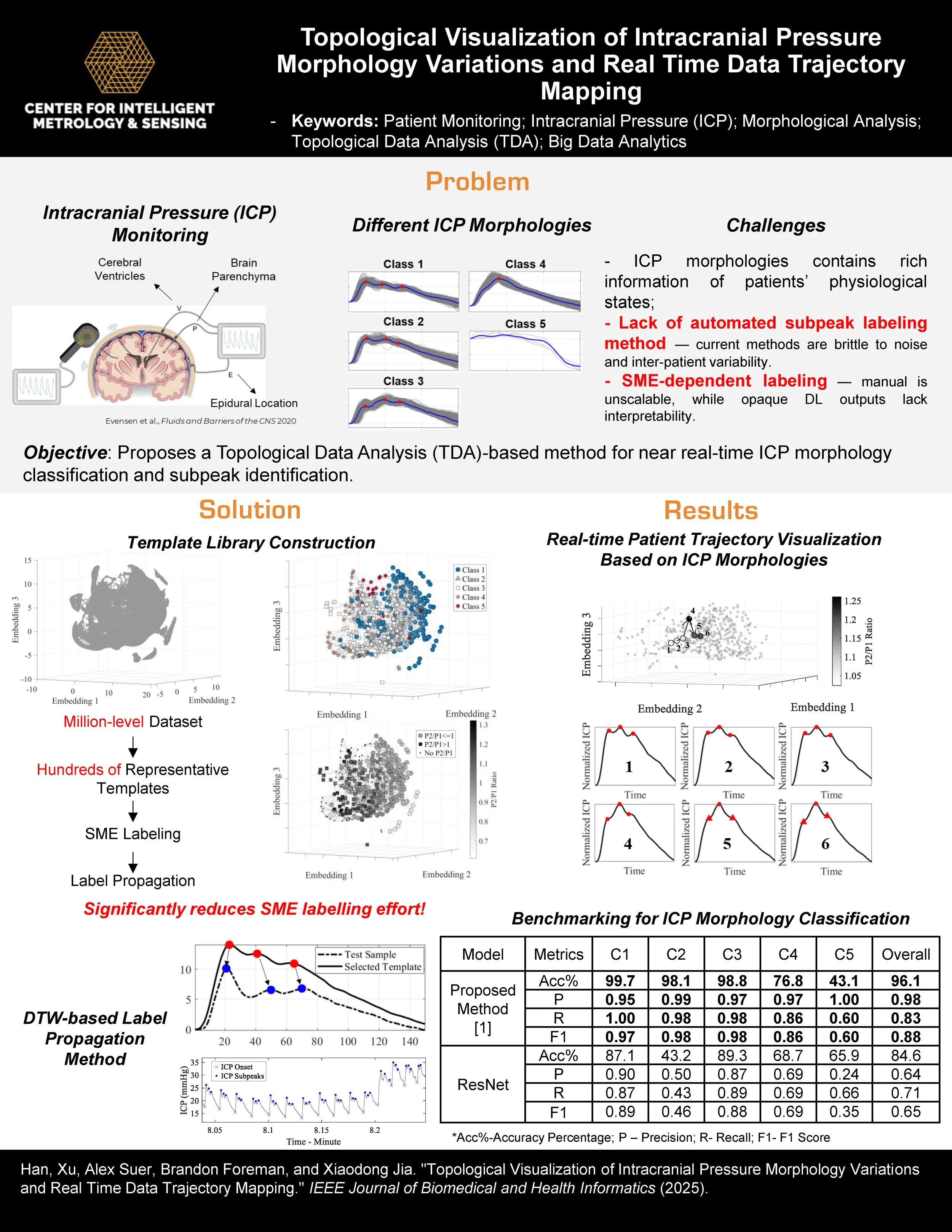
Intracranial pressure (ICP) monitoring is a cornerstone in the management of traumatic brain injury (TBI). However, clinicians often rely primarily on the mean ICP value, while the rich morphological information contained in individual ICP waveforms remains underutilized.
In this work, we introduce a Topological Data Analysis (TDA) framework that transforms over 1.2 million ICP waveforms from 60 TBI patients into an interpretable topological map. Instead of treating waveform classification, subpeak identification, and patient monitoring as separate problems, our approach integrates them into a unified framework for real-time clinical interpretation.
Some highlights:
✅ Built a topological representation from 1.2M+ ICP waveforms
✅ Achieved 96.1% waveform classification accuracy
✅ Achieved 97.3% subpeak identification accuracy
✅ Enabled real-time trajectory visualization of patient waveform evolution, allowing clinicians to monitor subtle physiological changes that may not be reflected by mean ICP alone.
Beyond this application, we believe this work demonstrates how Topological Data Analysis can make large-scale physiological data more interpretable by revealing the global structure of complex signals while supporting real-time monitoring.
Many thanks to my outstanding co-authors and collaborators for making this interdisciplinary project possible.
hashtag#ArtificialIntelligence hashtag#TopologicalDataAnalysis hashtag#BiomedicalEngineering hashtag#DigitalHealth hashtag#MachineLearning hashtag#Neuroscience hashtag#TraumaticBrainInjury hashtag#MedicalAI hashtag#SignalProcessing hashtag#IEEE