Designing Multi-View Speed and Separation Monitoring System for Multi-Robot and Multi-Human Interactions in Shared Workspace
I’m excited to share that our paper, “Designing Multi-View Speed and Separation Monitoring System for Multi-Robot and Multi-Human Interactions in Shared Workspace,” has been accepted for publication in the Journal of Manufacturing Systems.
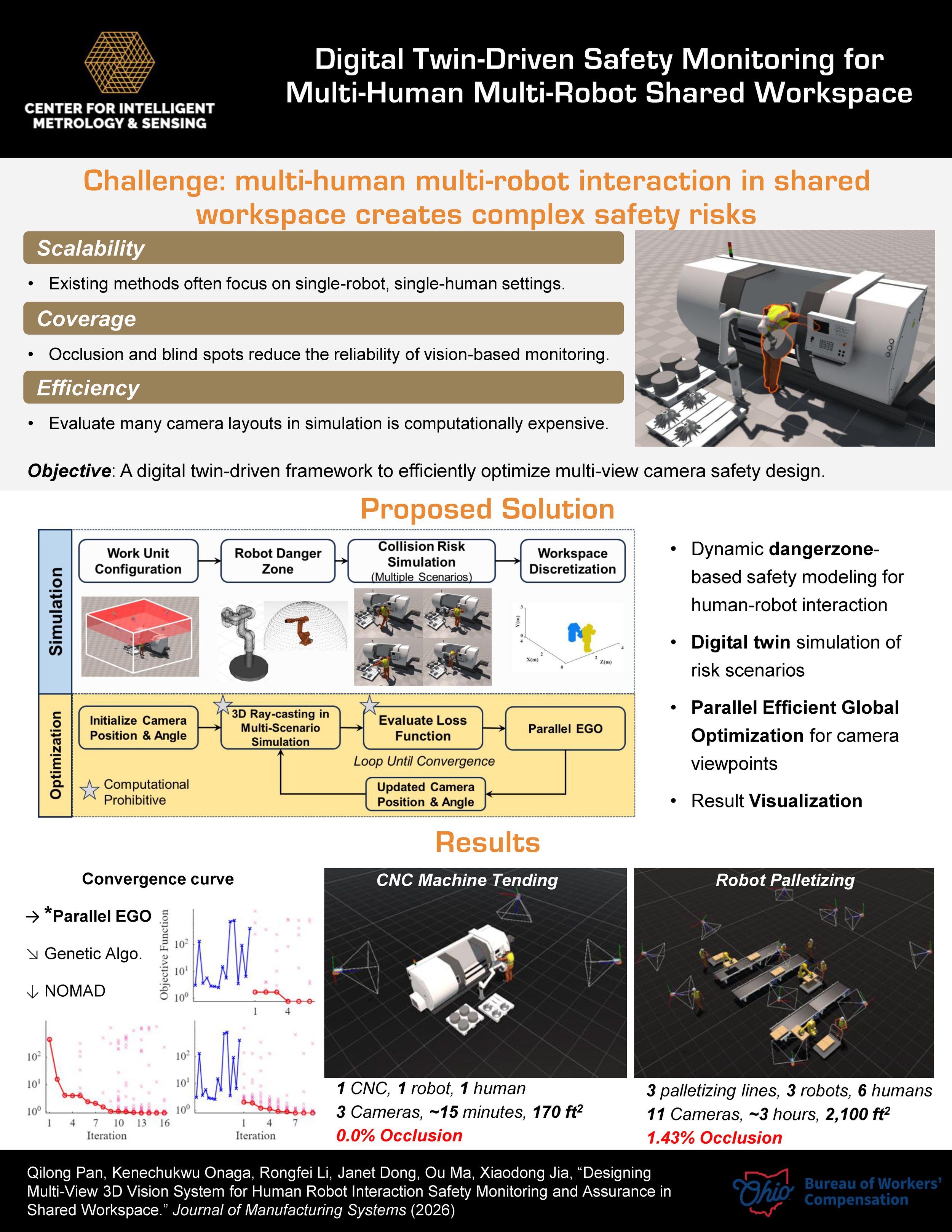
This work presents a simulation-driven methodology for designing multi-view Speed and Separation Monitoring (SSM) systems for shared workspaces involving multiple robots and multiple humans. The framework integrates:
- Probabilistic modeling of human motion
- Dynamic robot and end-of-arm-tool danger zones
- Voxel-based coverage and occlusion analysis
- Joint optimization of camera positions and orientations
- Parallel Efficient Global Optimization for computationally expensive design problems
The approach was evaluated in CNC machine-tending and multi-line palletizing environments. In the CNC case study, the optimized three-camera configuration achieved zero uncovered regions and only 1.25% overall occlusion, while substantially reducing the number of objective-function evaluations compared with Genetic Algorithms and NOMAD.
Congratulations to my co-authors Qilong Pan, Kenechukwu Onaga, Rongfei Li, Janet Dong, and Ou Ma. I sincerely appreciate everyone’s contributions to advancing safer and more scalable human–robot collaboration.